










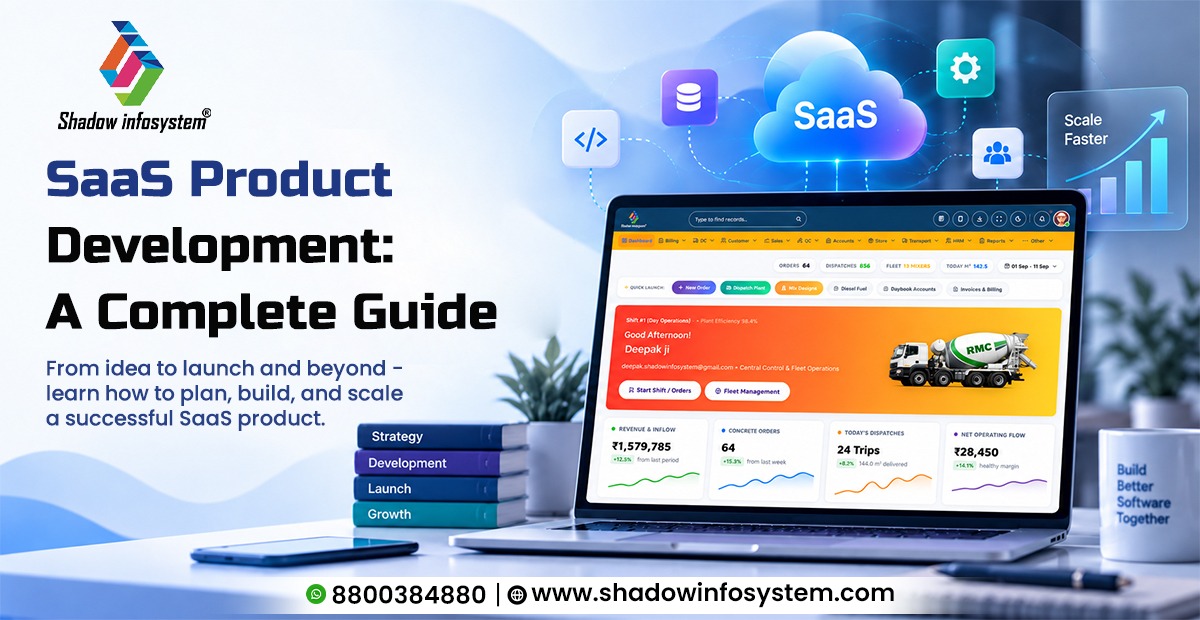
A major transformation in corporate operations has occurred with the development of software that runs in a web browser. Currently, 99% of companies employ at least one SaaS application. This has made the SaaS industry highly competitive and driven innovation in SaaS Product Development. Additionally, artificial intelligence, machine learning, and cloud computing solutions are driving the industry’s evolution. According to estimates, the worldwide SaaS industry will grow from its current value of $317.55 billion to $1,228.87 billion by 2032. Presently, companies can offer their clients useful solutions through a browser while experts resolve technical and security concerns behind the scenes.
What is a SaaS product?
SaaS stands for Software as a Service. It is software based in the cloud that can be accessed via a web browser. Unlike traditional software that required installation on all computers, there is nothing to download. Users pay a subscription fee monthly or annually, and the company supplying the software handles updates, security, and storage. That is why it’s easy to use the product anytime, anywhere with internet access. Examples of SaaS products include communication tools, project management software, accounting platforms, CRM systems, and cloud storage services. The main benefit is that users can focus on their work while the provider manages the technical side.
SaaS Product Development from Scratch
When designing a product from scratch, the first step is to validate whether there is an actual need for the product and whether users will pay to solve the problem. Skipping this validation step and moving straight to coding usually wastes time and resources. After validation, it becomes easier to move forward with a proper roadmap that guides feature design and development.
Define your product vision
Don’t jump straight into building. First, conduct thorough market research to identify your target audience’s problems and the solutions available today. Talk with potential customers, share your idea with them, and ask whether they’d buy. It is important to determine exactly what your future product will solve and how it will improve people’s lives. It may be helpful to discuss this topic in online communities and professional networks.
Clearly define your product’s core functionality
Once the concept is validated, determine the core features required in the initial version. The initial version is commonly referred to as a minimum viable product, and it consists of the core features required to solve the major problem. It is meant to allow a small number of people to use the product and provide feedback to influence future development. Building only the necessary features saves time and money because unnecessary features are not added.
Focus on user-friendly interface (UI) and user experience (UX) design
A product will succeed if people use it easily and enjoy it. It requires knowing a lot about what those people want, need, expect, and how they behave. One must be able to imagine what those people want or intend to achieve by opening the product, whether that means looking for information, doing a task, or making a decision. Researching how different types of users behave can help you design screens and flows that feel natural to them. When it feels natural, more people will start using the product.
Select a development process that meets your needs
Most groups prefer a more adaptable approach, which divides the task into smaller pieces with well-defined objectives in each phase. This enables faster progress and makes it easier to adjust based on user feedback. Instead of waiting for the product to be completed, the group may present certain pieces and receive user feedback to make improvements. Selecting the right process based on the project size and the group’s abilities will ensure continuous progress.
Test and iterate!
Tests must be conducted throughout the entire project. It can be beneficial to use both automated and manual testing, since this allows errors to be detected and corrected while they are still small. Involving real users at the very beginning will provide information that technical testing alone cannot capture. Analysts can analyze the feedback and data and recommend improvements for future versions of the product.
Pick the right tech stack
The selected technology must suit the team’s existing skill set, accommodate the anticipated number of users, and offer scalability potential. Technologies with popular communities and many off-the-shelf modules can save significant effort in development and maintenance. It is advisable to consider industry standards when selecting technologies, as this helps build a strong foundation. This will help avoid future difficulties when scaling the application.
Other considerations
It is essential to include proper security measures from the start to protect users’ information and meet requirements. It is also essential to have a good strategy for product release and maintenance. If you take this into account from the beginning, the final product will likely remain reliable and stable after release. Following the full process makes it more likely to create an effective solution.
Optimizing Your Existing SaaS Product for Growth
If a product has already launched, the focus shifts to identifying what works and what doesn’t. This can be done through observing customer reactions, usage, and competitor products. Through making consistent improvements, the product will remain relevant and continue growing.
Start by Identifying Areas for Improvement
By carefully analyzing the user feedback and support tickets, it will be possible to identify the pain points, feature requests, and confusing parts of the product. The number of people who abandon the product, and where they abandon it, can provide insight into the product’s problem areas. Competitor analysis may show gaps in competitors’ features and positioning that your product could fill. Usage metrics, such as the number of users and their time spent on the product, can indicate disengagement areas.
Prioritize and Execute Improvements
Once these challenges are identified, prioritize them based on their impact on user experience and retention. Urgent challenges are those that significantly impact user experience and retention. On the other hand, small improvements that can be achieved quickly will generate positive momentum for the product development process. Short-cycle iterations will enable the team to address issues and deliver consistent updates.
Scaling and Securing Your Infrastructure
As the number of users increases, the systems supporting the product need to be reviewed. Assessing server performance, database efficiency, and network capacity can identify weaknesses that hinder product performance or limit how many users can access the product. Strategies such as query optimization, load balancing, and cloud services can increase product scalability. Security is also important, as you need ways to ensure user data stays secure as the product grows.
Cost Considerations: In-House or Outsourced SaaS Product Development
Choosing who builds or improves the product affects both cost and future quality control. Some parties would rather handle the whole process internally, while others prefer working externally to achieve speed and specialization. Only by evaluating the pros and cons can you make a sound decision.
In-House Development
Keeping development within the firm ensures better control over the team and communication. Nonetheless, it requires considerable capital for recruitment, salaries, equipment, and training. It may be difficult to find professionals with the required skill set, especially in specialized areas. This is a good option for firms with strong technical expertise that want to keep the entire process under their own control.
Outsourced Development
Collaborating with an outside party can help reduce costs associated with large investments in the necessary infrastructure and dedicated staffing. Another benefit is access to additional skills that may not be available in-house. This is often the chosen course of action to make progress more quickly while maintaining budget flexibility. Effective communication and a properly set project scope are essential for a productive partnership. With proper management, this enables internal employees to focus on core business tasks.
Making the Right Choice
No universal solution fits all cases. The choice depends on budget, project complexity, access to competent staff, and the level of control required. Sometimes companies employ both methods in combination, where the core process is done internally while some aspects are outsourced because they need a unique set of skills.
If you want to develop your SaaS product through an outsourced product development company, Shadow infosystem can help you plan and develop a SaaS-based product to meet your business needs.
Conclusion
Developing any kind of software-as-a-service (SaaS) product requires understanding what users need, which features are priorities, and how best to implement them. A close connection with users and their real feedback, along with proper testing and plans for future growth, can ensure success. When people put a lot of effort and focus into developing SaaS products, they are likely to create something relevant to users and evolve with them.
If you are running a business and plan to develop your own SaaS-based product, it is highly recommended that you find a reliable, experienced developer. Contact Shadow infosystem to get technical support in developing your SaaS product.
FAQ
Q. What is SaaS product development?
SaaS product development is the process of building cloud-based software that users access through a web browser on a subscription basis, rather than installing it on individual machines. It covers idea validation, MVP definition, UI/UX design, development, testing, deployment, and ongoing maintenance, with the provider handling updates, security and storage.
Q. How is SaaS different from traditional software?
Traditional software is installed on each computer and usually bought with a one-time licence. SaaS runs in the cloud and is accessed through a browser on a monthly or annual subscription. The provider manages updates, security and data storage centrally, so users can access the product from anywhere with an internet connection.
Q. What are the steps in building a SaaS product from scratch?
Seven steps: validate that a real need exists and people will pay for it, define the product vision through market and customer research, identify the core features for an MVP, design the UI and UX around real user behaviour, choose a development process, test continuously with both automated and manual testing, and select a tech stack that matches your team’s skills and scales with growth. Security and a release plan should be built in from the start, not added later.
Q. What is an MVP in SaaS development?
A minimum viable product is the first version of a SaaS product, containing only the core features needed to solve the main problem. It is released to a small group of users whose feedback then shapes what gets built next. Building only essential features first saves time and money, because unnecessary features are never developed.
Q. How much does it cost to develop a SaaS product?
There is no fixed price. Cost is driven by the number of features in the first release, the complexity of the product, the tech stack, and whether you build in-house or outsource. In-house development means recruitment, salaries, equipment and training. Outsourcing avoids most of that upfront investment but requires a clearly defined project scope to stay on budget.
Q. Should I build my SaaS product in-house or outsource it?
In-house gives you tighter control over the team and communication, but needs significant investment in hiring, salaries and training, plus specialists who can be hard to find. Outsourcing gives faster access to specialised skills with more budget flexibility and frees internal staff for core business work. Many companies use both, keeping the core in-house and outsourcing the parts needing niche expertise.
Q. How do you validate a SaaS product idea?
Research the market to understand your target audience’s problems and what solutions already exist, then talk directly to potential customers and ask whether they would actually pay for yours. Online communities and professional networks are useful for testing the idea more widely. Skipping validation and going straight to coding is the most common way to waste time and money.
Q. How do you choose the right tech stack for a SaaS product?
Pick technologies your team already knows, that can handle the number of users you expect, and that leave room to scale. Stacks with large communities and ready-made modules cut development and maintenance effort considerably. Following industry standards at this stage avoids the scaling problems that are expensive to fix later.
Q. How do you scale a SaaS product as users grow?
Review server performance, database efficiency and network capacity to find the bottlenecks limiting performance or user numbers. Query optimisation, load balancing and cloud services all increase capacity. Security has to scale alongside it, so user data stays protected as the user base grows.
Q. How do you improve a SaaS product after launch?
Analyse user feedback and support tickets to find pain points and feature requests, track where users abandon the product, review usage metrics for disengagement, and study competitors for gaps you could fill. Prioritise fixes by their impact on user experience and retention, then ship in short cycles so improvements land consistently.