











Businesses are moving towards more flexible and efficient ways of managing their operations as technology and business requirements continue to evolve. With growing customer demands, expanding teams, and increasing operational complexity, companies need software that can keep pace with their changing needs.
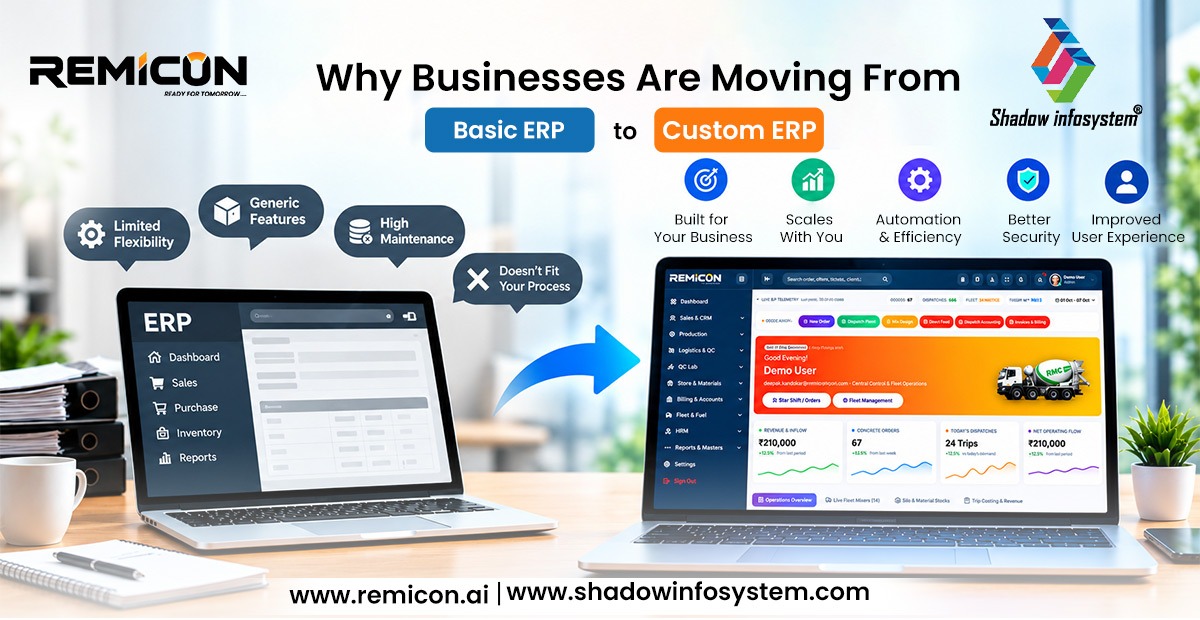
Basic ERP systems offer predefined features for common business activities and can work well for organisations with straightforward requirements. However, as businesses expand, they may need more flexible workflows, detailed reporting, better system integration, and industry-specific functionality that standard solutions may not fully support.
This is why more businesses are considering Custom ERP software. Instead of adapting every process to fit predefined features, organisations can choose functionality that aligns with their actual working methods. Custom ERP offers greater flexibility to streamline operations, automate routine tasks, connect departments, and build a system that supports long-term business growth.
Key Reasons for the Shift From Basic ERP to Custom ERP
As operational requirements grow, businesses need software that can support their processes more effectively. Moving from Basic ERP to Custom ERP allows organizations to address existing limitations while building a more flexible foundation for business growth.
1. Fixed Processes to Flexible Workflows
Basic ERP systems generally provide predefined workflows for common business activities. These workflows can work well when a company’s processes match the available functionality.
However, businesses with specialized operations may need different approval levels, department-specific procedures, or additional steps for handling transactions. When the software cannot accommodate these requirements, employees may have to adjust their working methods or manage certain activities outside the system.
Custom ERP allows businesses to plan workflows around their actual operating procedures. Approval sequences, transaction handling, departmental responsibilities, and other processes can be developed or configured according to business requirements.
This gives organizations greater control over how work moves across departments and helps employees follow processes that match their daily responsibilities.
2. Manual Work to Automated Workflows
Businesses often rely on employees to enter the same information into different records, prepare routine documents, or coordinate repetitive administrative tasks. As transaction volumes increase, these activities consume valuable working hours and can slow down other responsibilities.
Custom ERP provides an opportunity to streamline suitable repetitive tasks through configured workflows, connected records, and automation features. Routine actions can be triggered automatically when predefined conditions are met, depending on the system’s functionality.
This can reduce duplicate data entry, improve consistency, and help employees spend more time on important business activities. By reducing unnecessary manual work, organizations can improve operational efficiency without relying entirely on additional administrative effort as they grow.
3. General Reports to Business-Specific Insights
Predefined ERP reports provide useful information for common business requirements. However, management may need more detailed insights to understand performance across departments, locations, projects, or product categories.
Custom ERP allows businesses to plan reports and dashboards around their specific management priorities. Depending on operational requirements, these may include pending payments, inventory movement, operational expenses, production performance, sales figures, or dispatch status.
With relevant information available in an organized format, managers can review business performance more efficiently, identify areas that need attention, and make decisions based on the information that matters most to their organization.
4. Separate Systems to Connected Operations
Many businesses use different applications for accounting, inventory, customer management, communication, and other activities. When these applications operate separately, employees may need to transfer information manually or maintain multiple records.
Custom ERP provides an opportunity to connect relevant business functions through integrated modules and compatible applications. This helps information move more consistently between departments and reduces the need to maintain the same details across multiple systems.
For example, connected operational records can help relevant teams access updated information about orders, inventory, billing, or dispatch, depending on the system’s integration and workflow design.
A connected working environment makes it easier for departments to coordinate their activities and maintain consistent business information.
5. General Features to Industry-Specific Functionality
Basic ERP systems are designed to address common business activities. Their predefined features may not cover every specialized requirement of a particular industry.
Real estate companies manage property inventory, bookings, and payment collections. Manufacturing businesses focus on production, materials, procurement, and quality records. RMC businesses need to coordinate batching, inventory, quality control, dispatch, fleet, and billing.
Custom ERP allows organizations to prioritize functionality according to their industry and operational requirements. Businesses can select relevant modules, define specialized workflows, and organize records around their actual working processes.
This makes the system more practical for employees and helps businesses manage industry-specific activities through a solution designed around their needs.
6. Limited Expansion Options to Planned Scalability
Business growth can bring additional users, branches, plants, departments, and transaction volumes. Software requirements may also change as an organization introduces new services or expands its operations.
With custom ERP, businesses can consider these requirements while planning the system. User access, modules, integrations, infrastructure, and future development options can be aligned with the organization’s growth plans.
This creates greater flexibility when adding new operational requirements. Instead of relying only on the features available in a predefined package, businesses can plan future enhancements around their changing priorities and expansion goals.
7. Restricted Control to Greater Business Ownership
With Basic ERP, businesses generally depend on the software vendor’s available features, customization options, licensing conditions, and product roadmap. This can limit their control over how the system evolves.
Custom ERP provides greater flexibility to define development priorities and decide which business requirements should be addressed first. Organizations can work towards a solution that reflects their processes, reporting needs, and operational goals.
Source code ownership can also be included in the development agreement when required. Clearly defined ownership rights give businesses greater clarity regarding their rights to the developed software and its future use.
This makes custom development an attractive option for organizations that want more control over their business software and its long-term direction.
How Custom ERP Supports Business Growth
Custom ERP offers more than additional software features. Its real value lies in aligning business processes, information, and operational activities within a system that supports the organization’s objectives.
Key benefits include:
- Better process alignment: Workflows can reflect actual business procedures, approval requirements, and departmental responsibilities.
- Reduced repetitive work: Suitable routine activities can be streamlined through configured workflows and automation.
- Improved coordination: Connected records help departments access relevant information more consistently.
- Business-specific reporting: Dashboards and reports can focus on the information management needs to monitor.
- Industry-focused functionality: Dedicated modules can support specialized activities in manufacturing, construction, real estate, and RMC operations.
- Flexible user access: Permissions can be organized according to job roles and responsibilities.
- Greater development flexibility: Features and enhancements can be prioritized according to business requirements.
- Future growth support: Additional modules, integrations, users, and locations can be considered during system planning.
- More organized information: Relevant business records can be maintained through connected modules rather than scattered spreadsheets and disconnected applications.
By bringing these capabilities together, Custom ERP helps businesses create a more organized working environment, improve visibility across operations, and align their software with long-term business goals.
Basic ERP vs Custom ERP: What Is the Difference?
Both Basic ERP and Custom ERP help businesses organize information and manage operational activities. The main difference is the level of flexibility available to address specific business requirements.
| Comparison Factor | Basic ERP | Custom ERP |
| Definition | Software with predefined features and workflows for common business activities. | Software developed or configured around specific business requirements. |
| Functionality | Uses features available within the selected product. | Features are planned according to the agreed project scope. |
| Workflows | Uses workflows supported by the software. | Workflows can be developed or adapted to suit business procedures. |
| Customisation | Options depend on the product and its configuration capabilities. | Offers greater scope for business-specific changes. |
| Implementation Time | Often quicker because the core product is already developed. | Allows a planned development process based on business requirements. |
| Initial Cost | Generally lower when available features meet business needs. | Investment can be planned around the required features and development scope. |
| Reporting | Provides available reports and supported customisation options. | Can support reports designed around specific management requirements. |
| Scalability | Depends on available modules, integrations, and upgrade options. | Future changes can be planned according to system architecture and business priorities. |
| Maintenance | Follows the vendor’s support, maintenance, and update arrangements. | Can follow a support arrangement aligned with the development agreement. |
| Source Code Ownership | Generally remains with the software vendor, subject to licensing terms. | Ownership rights can be defined in the development contract. |
| Best Suited For | Businesses whose processes align with available features. | Businesses that need specialized workflows, greater flexibility, or business-specific functionality. |
Basic ERP provides a convenient starting point for businesses with standard requirements. Custom ERP is a stronger option for organizations that want greater flexibility, more relevant functionality, and software aligned with their operational priorities.
When Should a Business Consider Switching to Custom ERP?
Businesses should evaluate Custom ERP when their existing system no longer supports their operational requirements effectively. As processes become more complex, a more tailored solution can help address gaps and improve the way different departments work together.
Consider switching to Custom ERP when:
- Your business requires workflows that are not supported by the existing system.
- Employees spend considerable time preparing reports or maintaining duplicate records.
- Management needs specific dashboards to monitor business performance.
- Departments require better coordination between connected activities.
- Industry-specific operations need dedicated modules or specialized functionality.
- New branches, plants, or business units require additional system capabilities.
- Existing applications need integrations to improve information flow.
- You want greater control over software features and development priorities.
- Your long-term plans require functionality beyond the current system’s capabilities.
Moving to Custom ERP allows businesses to address these requirements through a solution planned around their priorities. By identifying essential features and future needs, organizations can build a more suitable system for their operations.
Introducing REMICON by Shadow infosystem for Custom ERP Solutions
Every business has its own operational processes, reporting requirements, and management priorities. From real estate and construction to manufacturing and other industries, organizations need ERP systems that align with their specific business requirements. This makes flexibility, industry understanding, and workflow alignment important considerations when choosing an ERP solution.
REMICON by Shadow infosystem offers ERP solutions designed to support business operations and management requirements. Our approach focuses on understanding how a business operates and providing relevant functionality to manage its processes, information, and routine activities more efficiently.
ERP for Different Industries
REMICON by Shadow infosystem supports the approach of aligning ERP functionality with industry-specific requirements. Different business sectors have different workflows, reporting needs, and operational priorities. Our ERP solution can help organize these activities through relevant modules and connected business records, depending on the industry and implementation scope.
- Real Estate: Property inventory, customer records, booking management, payment schedules, collections, and project-related reporting.
- Construction: Project costing, material procurement, contractor coordination, site expenses, resource management, and project progress tracking.
- Manufacturing: Production planning, inventory management, procurement, quality records, dispatch coordination, and operational reporting.
- RMC and Concrete Batching Plants: Order management, production and batching, inventory, quality control, dispatch, fleet management, weighbridge operations, billing, and financial records.
- Other Business Operations: Workflow management, department coordination, role-based access, business reporting, and other relevant functions based on specific requirements.
Each business’s required functionality depends on its processes, operational scale, and implementation scope. The objective is to align ERP functionality with actual business needs rather than assume that every organization requires the same features.
With REMICON by Shadow infosystem, businesses can explore ERP solutions based on their operational requirements, helping them organize workflows, improve coordination, and manage business information more effectively.
Cloud-Based ERP and Implementation Support
We offer a cloud-based, SaaS-based, rental-based ERP model, with the implementation approach determined by the applicable solution and business requirements. Our implementation process includes user acceptance testing (UAT) before go-live, along with online or offline training to help users understand the system.
We also provide role-based access and backup arrangements to support business operations and data management. Our backup approach includes daily, weekly, and monthly backups, with the most recent three days of daily backups retained. Data security requirements, access permissions, and recovery needs should be considered as part of the overall implementation.
Conclusion
The shift from standard ERP to custom ERP reflects the growing need for business management systems that align with specific workflows, industry requirements, reporting needs, and future growth plans. Choosing the right solution requires businesses to evaluate their operational challenges, identify functionality gaps, and determine which ERP approach best supports their objectives.
REMICON by Shadow infosystem helps businesses explore ERP solutions aligned with their operational and management requirements across different industries, including real estate, construction, manufacturing, and RMC. Our focus is on understanding business processes and providing relevant functionality to support workflow management, data visibility, and operational coordination.
Looking for a Custom ERP Solution for Your Business?
We can help you identify your ERP requirements and explore a solution suited to your business processes. Connect with Shadow infosystem to discuss your requirements and find the right ERP approach for your business.