











As modern businesses grow, the amount of data they generate, store, process, and share increases significantly. Customer information, financial records, employee details, business contracts, intellectual property, and confidential company documents have become essential assets for daily operations. However, as organisations expand their digital operations, protecting this information becomes increasingly challenging.
With employees accessing company resources from different locations, businesses adopting cloud applications, and teams regularly sharing files through emails and online platforms, the risk of data leakage and unauthorised data transfers continues to increase.
A single data exposure incident can result in financial losses, operational disruption, reputational damage, and potential legal consequences. This is why implementing a Data Loss Prevention (DLP) strategy has become an important part of modern business security.
A well-planned DLP strategy helps organisations identify sensitive information, monitor how it is accessed and shared, and prevent unauthorised data transfers. It enables businesses to maintain better control over their information while supporting secure and sustainable growth.
What Is a Data Loss Prevention (DLP) Strategy?
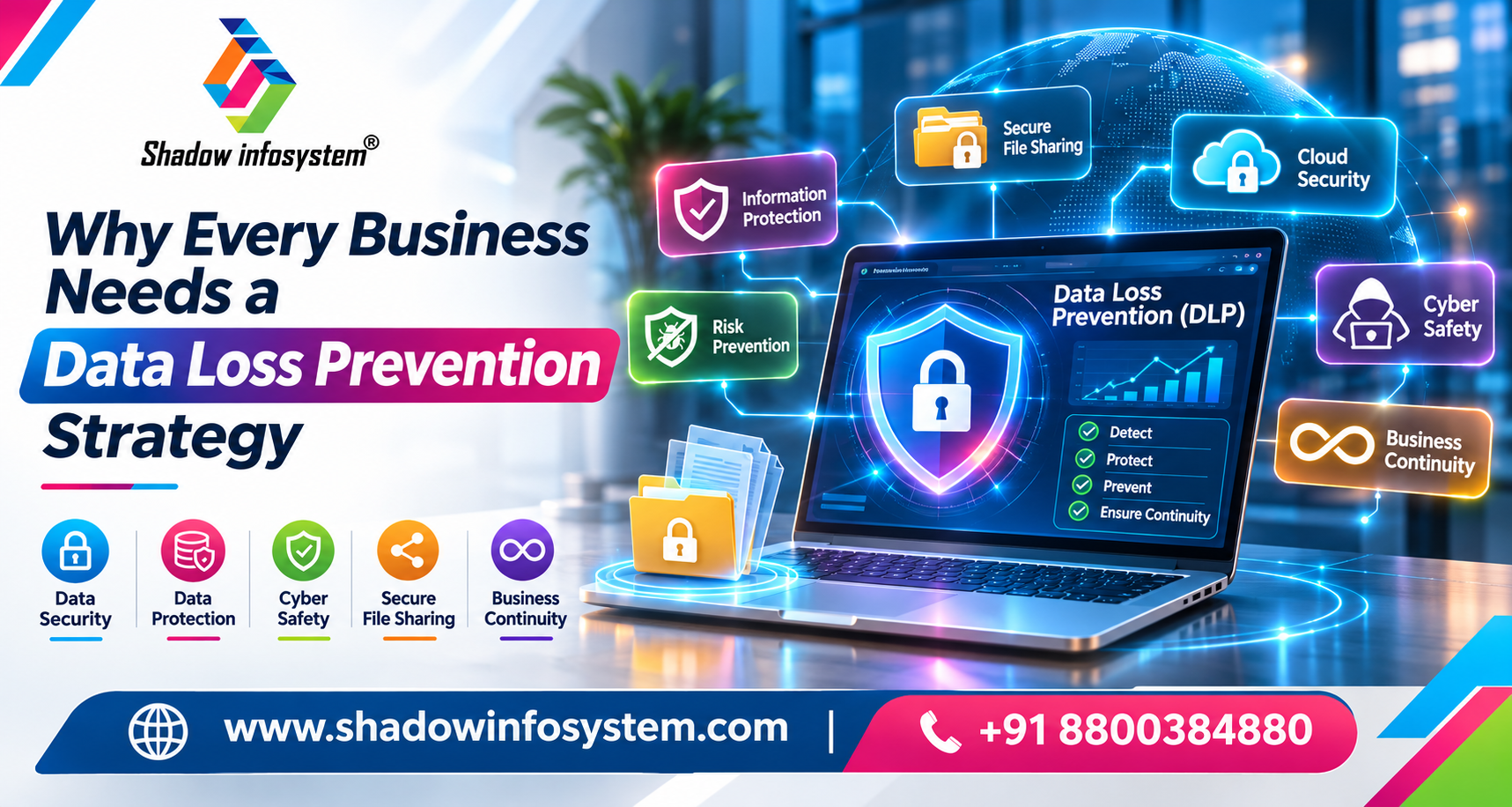
Data Loss Prevention (DLP) is a cybersecurity approach that focuses on identifying, monitoring, and protecting sensitive business information against unauthorised access, accidental exposure, misuse, or transfer.
A DLP strategy combines security technologies, organisational policies, employee awareness, and monitoring practices to protect confidential information throughout its lifecycle.
For example, consider a growing company that maintains thousands of customer records in spreadsheets. An employee may accidentally send a customer database to an external email address or upload confidential documents to an unauthorised cloud storage platform.
Without appropriate security controls, the organisation may not even know that sensitive information has been exposed.
A DLP system can identify sensitive information, recognise suspicious data-transfer activities, and apply predefined security policies to block or restrict unauthorised actions.
Depending on the technology and configuration, DLP solutions can protect data across:
- Endpoints: Desktop computers, laptops, USB drives, and other connected devices.
- Networks: Emails, internet traffic, file transfers, and network communications.
- Cloud platforms: Cloud storage, business applications, and online collaboration tools.
The objective is to ensure that sensitive information remains accessible to authorised users while preventing inappropriate data movement.
Why Growing Businesses Are More Vulnerable to Data Loss
Business expansion introduces new employees, departments, systems, customers, and technology platforms. Although these developments improve productivity, they also create additional security challenges.
Here are some common reasons why growing businesses need a structured data protection strategy.
1. Increasing Volume of Business Data
As an organisation expands, it collects and manages more information than before. Customer databases, transaction records, employee documents, financial reports, and operational files continue to grow.
Managing this information manually becomes difficult, particularly when multiple departments access and share the same resources.
Without proper data classification and monitoring, sensitive information may be shared with individuals who do not require access to it.
A DLP strategy helps organisations identify sensitive information and establish appropriate controls for accessing, storing, and transferring business data.
2. Employee-Related Data Leakage
Employees regularly handle confidential information as part of their responsibilities. However, not every data exposure incident happens because of malicious activity.
Common examples include:
- Sending confidential documents to the wrong email recipient.
- Copying company files onto personal USB drives.
- Uploading internal documents to personal cloud storage accounts.
- Sharing customer information through unauthorised messaging platforms.
- Downloading confidential files onto personal devices.
These activities may happen intentionally or accidentally.
A DLP solution helps monitor such activities and enforce policies that restrict unauthorised sharing of sensitive information.
3. Increased Use of Cloud Applications
Growing businesses increasingly depend on cloud-based platforms for communication, collaboration, file storage, and project management.
Applications such as Microsoft 365, Google Workspace, and other cloud services make information accessible across different locations and devices.
However, uncontrolled file sharing, incorrect permissions, and the use of unauthorised applications can expose confidential business information.
Cloud DLP capabilities help organisations monitor sensitive information stored or shared through supported cloud environments and apply appropriate security policies.
4. Remote and Hybrid Working Environments
Remote and hybrid working have changed how employees access company information.
Employees may connect to business applications from home networks, personal devices, or different geographical locations.
This creates additional challenges for organisations trying to maintain consistent data security controls.
A well-designed DLP strategy helps enforce information protection policies across supported endpoints, applications, and network environments, regardless of where employees work.
5. Insider Threats and Unauthorised Data Transfers
Insider threats are an important data security concern for organisations of all sizes.
An employee, contractor, or other authorised user may intentionally misuse their access privileges to copy or transfer confidential business information.
For example, an employee preparing to leave an organisation might download customer databases, financial documents, or proprietary business information.
DLP systems can help identify unusual data movement patterns and alert security teams when activities violate established policies.
Key Benefits of Implementing a Data Loss Prevention Strategy
A properly implemented DLP strategy provides several operational and security benefits.
1. Protects Confidential Business Information
Every organisation has information that should only be accessible to authorised individuals.
DLP helps protect customer records, financial information, employee details, contracts, business plans, and intellectual property.
By identifying sensitive data and applying appropriate controls, organisations can reduce the possibility of accidental or unauthorised exposure.
2. Reduces the Risk of Data Breaches
Data breaches can occur through compromised accounts, insider threats, misconfigured systems, or accidental information sharing.
DLP provides an additional layer of security by monitoring how sensitive information moves across supported systems.
Depending on its configuration, it can block unauthorised transfers, restrict file sharing, and generate alerts when suspicious activities are detected.
3. Improves Regulatory and Compliance Readiness
Organisations that process personal and sensitive information must consider applicable data protection and industry-specific requirements.
In India, the Digital Personal Data Protection Act, 2023, and the Digital Personal Data Protection Rules, 2025, are particularly relevant to organisations handling digital personal data.
DLP can support data protection efforts by helping organisations identify sensitive information, monitor data movement, and enforce internal security controls.
However, DLP alone does not guarantee legal or regulatory compliance. Businesses must also address access management, consent requirements, data retention, incident response, and other applicable obligations.
4. Strengthens Employee Data Security Practices
A DLP strategy encourages employees to handle business information responsibly.
Organisations can establish clear policies regarding:
- Sharing confidential documents.
- Using personal email accounts.
- Connecting external storage devices.
- Uploading files to cloud platforms.
- Accessing customer and financial records.
Combined with regular security awareness training, these policies help create a stronger data protection culture.
5. Protects Business Reputation and Customer Trust
Customers expect businesses to handle their personal and confidential information responsibly.
A data exposure incident can damage customer relationships and reduce confidence in an organisation’s ability to protect information.
Implementing appropriate data security measures demonstrates that an organisation takes information protection seriously.
6. Supports Business Growth and Digital Transformation
Growing businesses frequently adopt new technologies, hire employees, establish new branches, and expand their customer base.
Without scalable security controls, every expansion can introduce additional data protection challenges.
A DLP strategy provides a structured approach to managing information security as the organisation grows.
It helps businesses adopt digital tools while maintaining better control over sensitive information.
Understanding the Digital Personal Data Protection Act (DPDP Act), 2023
The Digital Personal Data Protection Act (DPDP Act), 2023, establishes a legal framework for protecting digital personal data in India. It focuses on how organisations collect, process, store, and use individuals’ personal information while recognising their privacy rights.
For businesses handling customer details, employee records, contact information, and other digital personal data, understanding the DPDP Act is an important part of building responsible data protection practices.
The Digital Personal Data Protection Rules, 2025 were notified in November 2025 to provide a framework for implementing the Act. These provisions introduce responsibilities for organisations known as Data Fiduciaries, which determine the purpose and means of processing personal data.
Some important aspects businesses should understand include:
- Consent and Transparency: Organisations must follow applicable requirements for obtaining consent and clearly communicating why personal data is being collected and processed.
- Purpose Limitation: Personal information should be processed for the purposes permitted under the Act.
- Data Security: Businesses must implement appropriate technical and organisational measures to protect personal data against unauthorised access and breaches.
- Data Retention: Personal information should not be retained longer than permitted under applicable legal requirements.
- Breach Management: Organisations must follow applicable personal data breach notification requirements.
- Individual Rights: Data Principals have rights concerning their personal data, including access to information, correction, erasure, and grievance redressal, subject to the Act.
Types of Data Loss Prevention Solutions Businesses Should Understand
Different DLP technologies protect information across different environments. Depending on business requirements, organisations may implement one or more of the following solutions.
1. Endpoint Data Loss Prevention
Endpoint DLP focuses on protecting information accessed or transferred through employee devices such as desktops and laptops.
It can help monitor activities including:
- Copying files to USB drives.
- Printing confidential documents.
- Copying sensitive information to the clipboard.
- Transferring files between supported applications.
- Moving information to external storage devices.
Endpoint DLP is particularly useful for organisations where employees regularly handle confidential information on company-managed devices.
2. Network Data Loss Prevention
Network DLP monitors data moving across an organisation’s network.
It can identify sensitive information being transmitted through supported communication channels, including email, web uploads, and network file transfers.
Depending on deployment architecture, network DLP can detect policy violations and block unauthorised data transfers.
3. Cloud Data Loss Prevention
Cloud DLP focuses on protecting sensitive information stored, processed, or shared through cloud applications and services.
It can help organisations identify confidential information in supported cloud environments and monitor activities such as external file sharing and inappropriate access.
This is particularly important for businesses using cloud storage, online collaboration tools, and SaaS applications.
How to Develop an Effective Data Loss Prevention Strategy
Implementing DLP software without a clear security plan may result in unnecessary restrictions, operational difficulties, and ineffective protection.
Businesses should follow a structured implementation approach.
Step 1: Identify and Classify Sensitive Data
Start by identifying the types of information your organisation stores and processes.
Examples include:
- Personally identifiable information.
- Customer databases.
- Financial and accounting records.
- Employee information.
- Intellectual property.
- Business contracts and confidential reports.
Classify this information according to its sensitivity and business importance.
For example, organisations may use categories such as Public, Internal, Confidential, and Highly Confidential.
Step 2: Understand How Data Moves Across the Organisation
Identify where business information is stored, who can access it, and how employees share it.
Review data movement through:
- Corporate email systems.
- USB and external storage devices.
- Cloud storage platforms.
- Business applications.
- Internal networks.
- Remote access environments.
Understanding these workflows helps identify potential data exposure points.
Step 3: Establish Clear Data Protection Policies
Develop policies that define how employees can access, use, store, and share sensitive information.
For example, an organisation may establish rules that:
- Restrict copying confidential files to unauthorised USB devices.
- Prevent sensitive customer information from being emailed to personal accounts.
- Limit external sharing of confidential business documents.
- Require approval before transferring specific categories of information.
Policies should be practical and aligned with actual business requirements.
Step 4: Select the Right DLP Technology
Choose a DLP solution based on your organisation’s size, infrastructure, data sensitivity, and security requirements.
Evaluate important capabilities such as:
- Data discovery and classification.
- Endpoint monitoring.
- Email protection.
- USB device controls.
- Cloud application monitoring.
- Policy-based blocking.
- Real-time alerts.
- Reporting and audit capabilities.
The selected solution should integrate effectively with the organisation’s existing technology environment.
Step 5: Implement DLP Policies in Phases
Instead of immediately blocking every activity, organisations should consider a phased deployment.
A practical approach is to begin with monitoring and visibility, identify common policy violations, and gradually introduce restrictions.
This reduces unnecessary business disruption and helps security teams fine-tune policies.
Step 6: Train Employees and Review Security Policies
Technology alone cannot eliminate every data leakage risk.
Employees should understand why data protection matters and how to handle confidential information responsibly.
Conduct regular awareness sessions, review access permissions, and update security policies as the organisation’s technology and business operations evolve.
Step 7: Monitor, Evaluate, and Improve
DLP implementation should be treated as an ongoing security process rather than a one-time project.
Regularly review:
- Data leakage alerts.
- Policy violations.
- Unauthorised file transfers.
- Endpoint activity.
- Cloud sharing permissions.
- Security incidents.
- False-positive alerts.
These insights help organisations improve their data protection controls over time.
Choose Shadow infosystem for Data Loss Prevention Solutions?
Choosing the right technology partner is an important part of building an effective Data Loss Prevention strategy. Businesses need more than just security software; they need a solution that aligns with their infrastructure, operational requirements, and data protection objectives.
At Shadow infosystem, we focus on helping organisations strengthen their data security practices through suitable cybersecurity technologies, DLP implementation support, and technical assistance.
Our approach is centred on understanding business-specific security requirements and helping organisations establish appropriate controls to protect their confidential information.
Our Comprehensive Data Loss Prevention Services
1. Data Security Assessment
We help businesses identify potential data leakage risks, understand how sensitive information moves across their organisation, and evaluate existing data protection practices.
2. DLP Solution Planning and Implementation
We help organisations plan and implement appropriate DLP solutions based on their business requirements, existing IT infrastructure, and security objectives.
3. Endpoint and USB Data Protection
We assist in establishing suitable controls over external storage devices, file transfers, and endpoint activities to minimise the risk of unauthorised data movement.
4. Email and Cloud Data Protection
We help strengthen data protection across supported email systems and cloud environments through appropriate monitoring and security policies.
5. DLP Policy Configuration
We assist businesses in configuring data protection policies according to their operational needs, helping them balance information security with employee productivity.
6. Technical Support and Security Management
We provide technical assistance to help organisations review their DLP environment, address implementation challenges, and improve their data protection practices over time.
Protect Your Business Information with the Right DLP Solution
Whether you are a growing business looking to establish your first data protection framework or an established organisation seeking to strengthen existing security controls, implementing the right DLP strategy can make a significant difference.
With a business-focused approach to cybersecurity, Shadow infosystem aims to help organisations strengthen data protection, reduce information leakage risks, and build a more secure digital working environment.
Looking to implement Data Loss Prevention solutions for your organisation?
Connect with Shadow infosystem to discuss your DLP requirements and explore suitable data protection solutions for your business.