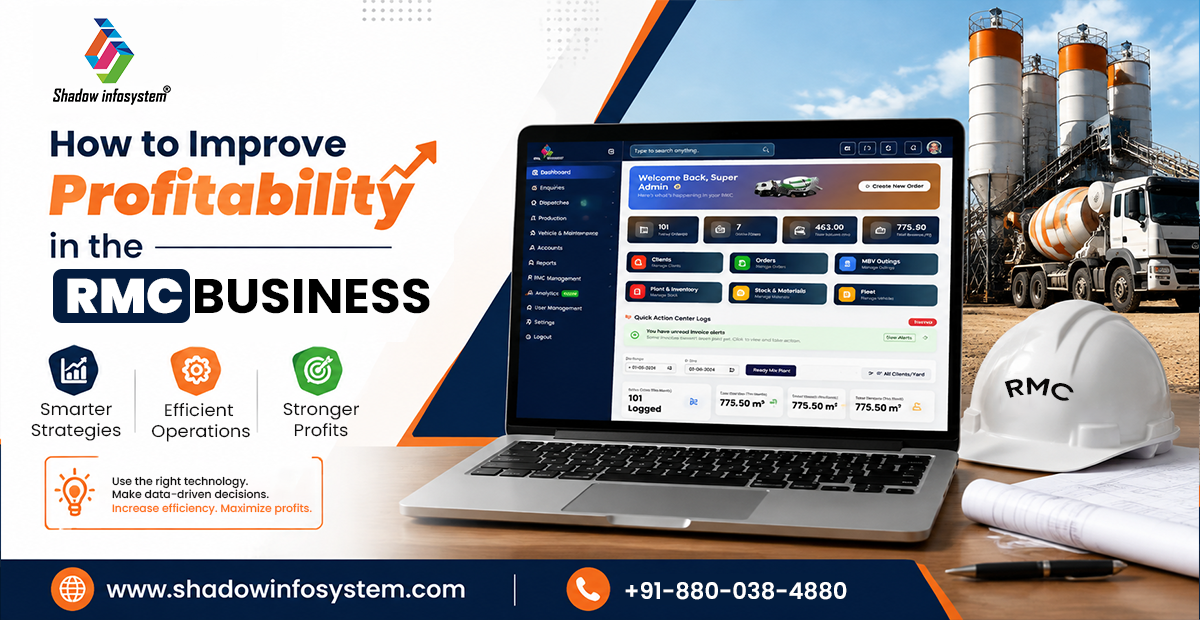












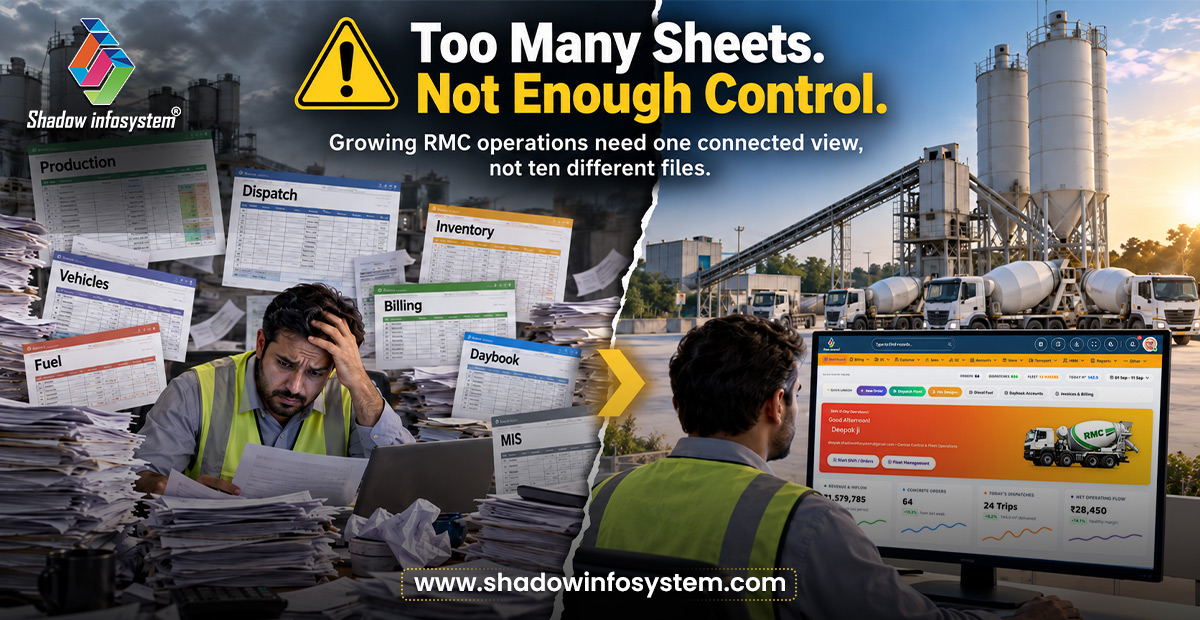
Businesses are moving toward AI-powered operations, but are you still managing your RMC plant’s daily activities through Excel spreadsheets?
For RMC owners, the real problem with Excel is not the spreadsheet itself. It is the lack of control when important information is spread across different files. How much material was used today? Which vehicles are still on the road? How much concrete was produced and dispatched? Is the daybook updated with daily transactions and expenses? Are there any billing or payment issues? When teams have to check different sheets, update the daybook manually, call other departments, or wait for information, decisions take longer. These delays can increase costs, cause missed issues, create errors in records, and make it harder to understand the plant’s actual performance.
With AI changing how businesses manage data and operations, the question is no longer whether Excel can store the data. The real question is whether it can provide the speed, accuracy, automation, and real-time visibility needed to run the plant efficiently. Modern RMC operations need more than spreadsheets to handle complex workflows and support faster decisions. RMC plant management software connects critical plant activities in one system, giving owners and managers access to current information, reducing manual work, improving operational visibility, and creating a stronger foundation for AI-supported, data-driven decision-making.
Why RMC Plants Still Rely on Excel Sheets?
Excel remains common in the ready-mix concrete industry because it is familiar, accessible, and inexpensive to start with. However, what works for basic records can quickly become a problem as the business grows. As transactions, employees, vehicles, materials, and plants increase, spreadsheet-based management becomes hard to control.
Managing production, dispatch, inventory, vehicles, billing, and quality through separate Excel sheets creates data gaps, repetitive work, delayed updates, and frequent errors. Teams spend valuable time entering, checking, and consolidating information instead of focusing on operations. This dependence can slow decision-making, increase operational risks, and make business expansion harder.
Dedicated RMC software addresses these limitations by connecting critical workflows in one system, giving businesses better control, real-time visibility, preventing fuel leakage, and a more scalable way to manage plant operations.
The Hidden Costs of Using Excel for RMC Plant Operations
The biggest problem with Excel is not the spreadsheet itself. It is the dependence on manual processes when the operation requires continuous coordination.
Manual Data Entry Errors
RMC operations involve large quantities of cement, aggregates, admixtures, and other materials. A small data-entry mistake can affect records further down the process.
Common issues include:
- Batch quantity mismatches
- Incorrect mix design inputs
- Human errors in raw material consumption records
- Duplicate or missed entries
- Incorrect calculations caused by formula or input errors
When teams have to cross-check these records manually, valuable time is spent finding and correcting information instead of managing the plant.
Lack of Real-Time Visibility
An Excel sheet only reflects the information entered into it. If production or dispatch data is updated later, management does not have a live view of what is happening at the plant.
This can make it difficult to answer basic operational questions quickly, such as how much has been produced, what has been dispatched, which vehicles are on the move, or how much inventory is currently available.
Real-time visibility becomes particularly important when plant owners or managers need to monitor operations from another location.
Disconnected Departments & Data Silos
Production, dispatch, quality, inventory, sales, and accounts may each maintain separate spreadsheets. While each department may have its own record, bringing everything together can become a time-consuming process.
This creates data silos where information exists but is not easily connected. Management may have to collect multiple files, compare entries, resolve mismatches, and prepare a consolidated report before making a decision.
Inventory & Raw Material Mismanagement
RMC plants depend on the continuous availability of cement, aggregates, admixtures, and other materials. Spreadsheet-based inventory management makes it harder to maintain a current picture of stock across operations.
Without automated tracking and alerts, businesses may experience:
- Overstocking of materials
- Unexpected stockouts
- Delayed procurement
- Difficulties tracking consumption
- Limited visibility into material costs
An integrated inventory system can connect material consumption with production and procurement records for better control.
Quality Control Gaps
Consistency is critical in ready-mix concrete production. Mix designs, material quantities, and quality-related records need to be properly maintained and accessible.
When these details are managed through separate sheets, teams may struggle to maintain standardized records across batches. Retrieving historical information for verification can also take unnecessary time.
A dedicated system can centralize mix design and quality information, helping teams maintain more structured production records.
Billing, Invoicing & Compliance Challenges
Billing is another area where manual processes can create avoidable problems. Teams may need to transfer information from dispatch records into invoices, verify quantities, and reconcile payments separately.
This can result in:
- Invoice generation errors
- Mismatched dispatch and billing information
- Delays in payment reconciliation
- Additional manual checking
- Increased risk of tax or GST-related errors
Connecting dispatch, billing, and financial information can make the process more consistent and easier to monitor.
Time-Consuming Reporting Process
Preparing MIS reports manually can consume hours, particularly when information has to be collected from several departments or plants.
Managers may spend significant time preparing reports instead of analyzing them. By the time the report is ready, some of the information may already be outdated.
Automated dashboards and reporting help management move from collecting data to actually using it.
How These Excel-Related Issues Impact Your RMC Business
The problems created by disconnected spreadsheets do not remain limited to the accounts or plant office. They can affect the overall performance of the business.
Reduced Plant Efficiency & Productivity
When employees spend time entering, comparing, correcting, and consolidating data, less time is available for productive operational activities. Delays in one department can also affect other parts of the plant.
Increased Operational Costs
Manual processes increase administrative workload and make it harder to identify avoidable costs. Poor inventory visibility, vehicle inefficiencies, fuel leakage, billing errors, and delayed decisions can all affect profitability.
Customer Dissatisfaction
Customers expect concrete to be delivered according to agreed schedules and quantities. Dispatch delays, incorrect billing, or communication gaps can affect their experience and weaken business relationships.
Poor Decision-Making Due to Inaccurate Data
Management decisions depend on reliable information. If different departments maintain different figures, it becomes difficult to identify which number is correct. This can affect production planning, procurement, sales, inventory, and financial decisions.
Scalability Challenges as Plant or Business Grows
A spreadsheet system that works for one small plant may become increasingly difficult to manage when production volume increases, or additional plants are added. More employees, vehicles, customers, and transactions mean more files and more opportunities for data inconsistencies.
Signs It’s Time to Move Beyond Excel Sheets
Your RMC operation may be ready for dedicated software if you regularly face these situations:
- Frequent data mismatches between departments
- Delayed daily production or dispatch reports
- Difficulty tracking multiple plants from one location
- Manual errors in billing and challans
- No real-time inventory visibility
- Repeated problems with vehicle and trip records
- Difficulty monitoring fuel consumption and identifying leakage
- Growing plant operations outpacing spreadsheet capacity
- Too much time spent preparing MIS reports
- Management depends on employees to manually collect operational updates
If several of these issues sound familiar, the problem may no longer be Excel itself. It may be that the business has outgrown a spreadsheet-based operating model.
The Smarter Choice: RMC Plant Management Software
RMC plant management software is a specialized digital system designed to manage and connect the core activities of a ready-mix concrete business.
Instead of maintaining separate records for production, dispatch, inventory, vehicles, sales, quality, procurement, and accounts, an integrated RMC system brings relevant information into one connected platform.
The objective is simple: reduce manual dependency, improve data accuracy, provide real-time visibility, and help management control plant operations more effectively.
Key Features to Look For RMC ERP Software
When selecting RMC plant management software, businesses should evaluate whether it supports their complete operational workflow.
Important capabilities include:
- Automated batching and production tracking: Record production activities and monitor material consumption more systematically.
- Real-time dispatch and vehicle tracking: Track dispatch activity and connect vehicle information for better fleet visibility.
- Integrated inventory management: Monitor raw materials, consumption, procurement, and stock levels.
- Digital challan and GST-compliant invoicing: Reduce repetitive billing work and improve consistency between dispatch and invoices.
- Multi-plant dashboard and reporting: Monitor operations across multiple plants through centralized dashboards and MIS reports.
- Quality control and mix design management: Maintain structured mix design and quality-related records.
- Fuel management: Record fuel issues and consumption to improve monitoring and identify unusual usage.
- Vehicle management: Manage vehicle records, insurance details, driver information, and driving license expiry tracking, with secure integration of third-party GPS solutions through API connectivity for real-time vehicle tracking and enhanced fleet visibility.
Choose Shadow infosystem for RMC ERP Software
Shadow infosystem provides RMC ERP software designed to bring major ready-mix concrete operations onto a connected platform. The system supports production, quality, dispatch, vehicles, sales, inventory, procurement, trip planning, maintenance, fuel management, billing, receivables, payables, expenses, financial reporting, MIS, dashboards, and multi-plant operations.
With real-time visibility across operations, management can access relevant information without depending entirely on manually consolidated Excel reports.
Shadow infosystem RMC ERP also supports fleet-related processes, including vehicle records, driver information, insurance tracking, driving licence expiry monitoring, fuel issue records, and third-party GPS API integration for real-time vehicle tracking.
For RMC businesses operating in Delhi NCR, Greater Noida, Gurugram, and other locations, the platform can provide a structured digital foundation for managing growing plant operations.
Benefits of Switching from Excel to Our ERP Software
- Improved accuracy: Automated processes reduce repetitive manual entry and minimize opportunities for human error.
- Real-time data: Authorized users can access production, dispatch, inventory, and other operational information without waiting for manually prepared reports.
- Faster reporting: MIS reports and dashboards reduce the effort required to collect information from different departments.
- Better inventory and cost control: Connected consumption and inventory records provide greater visibility into material usage and related costs.
- Multi-plant scalability: Centralized visibility becomes increasingly valuable as businesses operate multiple RMC plants.
- Fuel leakage control: Digital fuel issue and consumption records make it easier to monitor fuel usage and identify unusual patterns that require attention.
- Vehicle tracking: Fleet management can support secure third-party GPS API integration for real-time vehicle tracking and enhanced fleet visibility.
Is Your RMC Plant Ready for AI-Driven Operations?
Excel may work for basic record-keeping, but as an RMC business grows, managing production, dispatches, vehicles, inventory, quality, billing, payments, and multiple plants across separate sheets becomes increasingly difficult. The result can be delayed reports, manual errors, disconnected data, inventory mismatches, billing issues, and limited visibility for owners.
With AI and automation becoming an important part of modern business operations, RMC owners need systems that can do more than simply store information. The right RMC plant management software can connect daily operations in one system, reduce repetitive work, provide real-time data, manage the daybook, and help owners make faster, data-driven decisions.
Ready to take better control of your RMC plant? Switch to Shadow infosystem’s RMC ERP solution and see how integrated production, dispatch, inventory, vehicle, quality, billing, and reporting workflows can help you manage operations more efficiently.
Frequently Asked Questions
What is RMC ERP software?
RMC ERP software is a centralized system for managing production, quality, dispatch, sales, inventory, vehicles, finance, and plant operations with real-time visibility across RMC business activities.
How is RMC ERP different from normal accounting software?
RMC ERP goes beyond accounting by connecting production, dispatch, quality, inventory, vehicles, sales, and finance, giving RMC businesses complete operational visibility alongside financial management.
Can I check production and dispatch from my phone?
Yes, Shadow infosystem enables mobile access to RMC operations, allowing authorized users to monitor production, dispatch, sales, and other essential plant activities from their phones.
Will it work with my existing GPS devices?
Yes, Shadow infosystem provides third-party API integration, enabling the RMC ERP system to connect with compatible existing GPS devices and access relevant vehicle tracking information within operations.
Does it connect to my weighbridge?
Yes, RMC ERP software can support weighbridge integration where compatible, helping capture relevant weight data digitally and connect weighing information with production, dispatch, and billing workflows.
Is GST billing included?
Yes, RMC ERP software includes GST invoicing capabilities, helping RMC businesses generate compliant invoices while connecting billing information with sales, receivables, dispatch, and overall financial records.
How does quality control work in the system?
RMC ERP software centralizes quality-related records, helping teams monitor mix details, testing information, material usage, and quality processes while maintaining accessible records for operational control.
What is a Daybook in RMC plant management software?
A Daybook in RMC plant management software records daily plant activities, including sales, purchases, expenses, receipts, payments, production, dispatch, and other operational transactions.
Can RMC ERP software manage the daily Daybook automatically?
Yes, Shadow infosystem’s RMC ERP software can streamline daily Daybook management by recording relevant transactions systematically, reducing manual data entry and providing organized, accessible financial information for plant operations.